Case study / Service design & research
Graduates can describe their skills. Proving them is the hard part.
BPI Chain is an online database that uses blockchain and smart contracts so service design students can prove their abilities and experience to companies in the industry.
10 weeks
Design lead, research lead
Joe Parker, Andrew Bateman, Isabela Muñoz
Two questionnaires, expert interviews, stakeholder and persona analysis, affinity diagrams, hypothesis testing
Employability for new service design graduates
Credibility database with blockchain integration
01 / The problem
Nobody agrees on what makes an effective service designer.
New graduates of service design lack the experience industry organizations are looking for, and need a way to prove their employability. Service designers are academically trained in a range of technical skills that contribute to their effectiveness, but there is a gap in the understanding of what actually makes an efficient service designer.
The solution
A mechanism to accurately contextualize and communicate a service designer's experience and compatibility to recruiters, and a framework to improve the academic development process of earning the degree.
02 / Research
Two questionnaires and twelve expert interviews.
Mapping the gap
Research gap matrix, stakeholder analysis, persona analysis, memory basin, affinity diagrams, word frequency analysis.
Testing the idea
Deductive workshop, interface testing, idea visualization testing.
Validating
Hypothesis testing across both student and recruiter groups.
03 / Research insights
Four findings that shaped the concept.
Proof builds trust
Documentation and measuring are crucial to proving oneself and gaining trust.
Soft skills lead
Soft skills matter most, while hard skills can be developed.
Experience is three things
Time, knowledge, and work.
Ownership scales
Students can delegate and take ownership of roles based on experience.
04 / Objectives
Three things the solution had to do.
A shared framework
Create a framework to communicate the value of service designers.
Close the gap
Connect recruiters and new graduates so that the experience and skills of those graduates are actually communicated.
Feed it back
Implement industry principles into the academic program to better prepare students for professional work.
05 / Tech integration
A credibility database on a blockchain.

Credibility database
A record of what a designer has actually done, structured so it can be read and compared rather than described.

Blockchain integration
Smart contracts make those records verifiable, so a claim carries proof with it.
Immutable records
Transactions are recorded in a way that cannot be edited after the fact.
Public or private
Acts as a database that can be opened or restricted depending on the context.
Proof for recruiters
Gives a designer a mechanism to prove their worth to a recruiter.
06 / How it works
Two journeys, one record.
Students journey
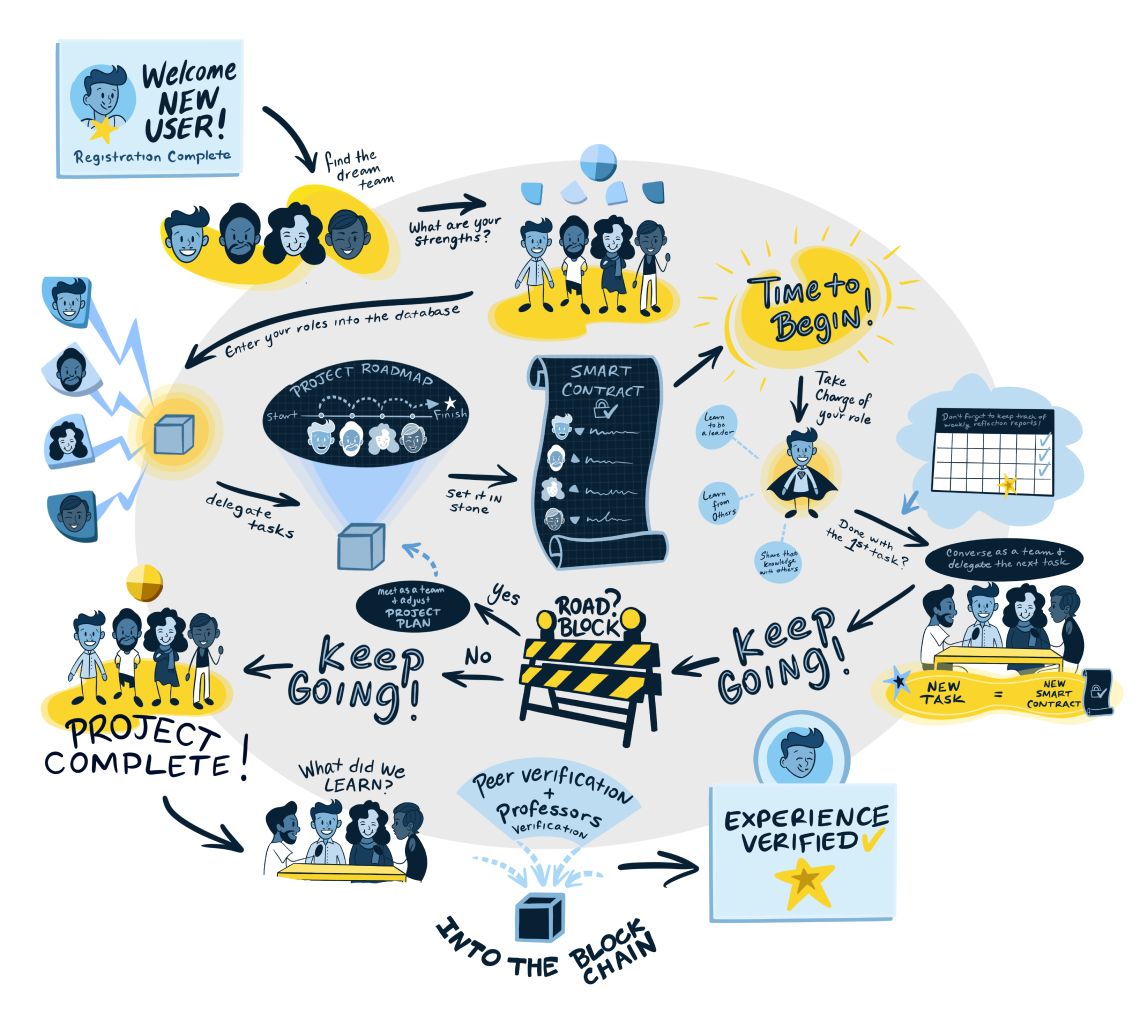
How a student builds and adds to the record across the course of their degree.
Recruiters journey
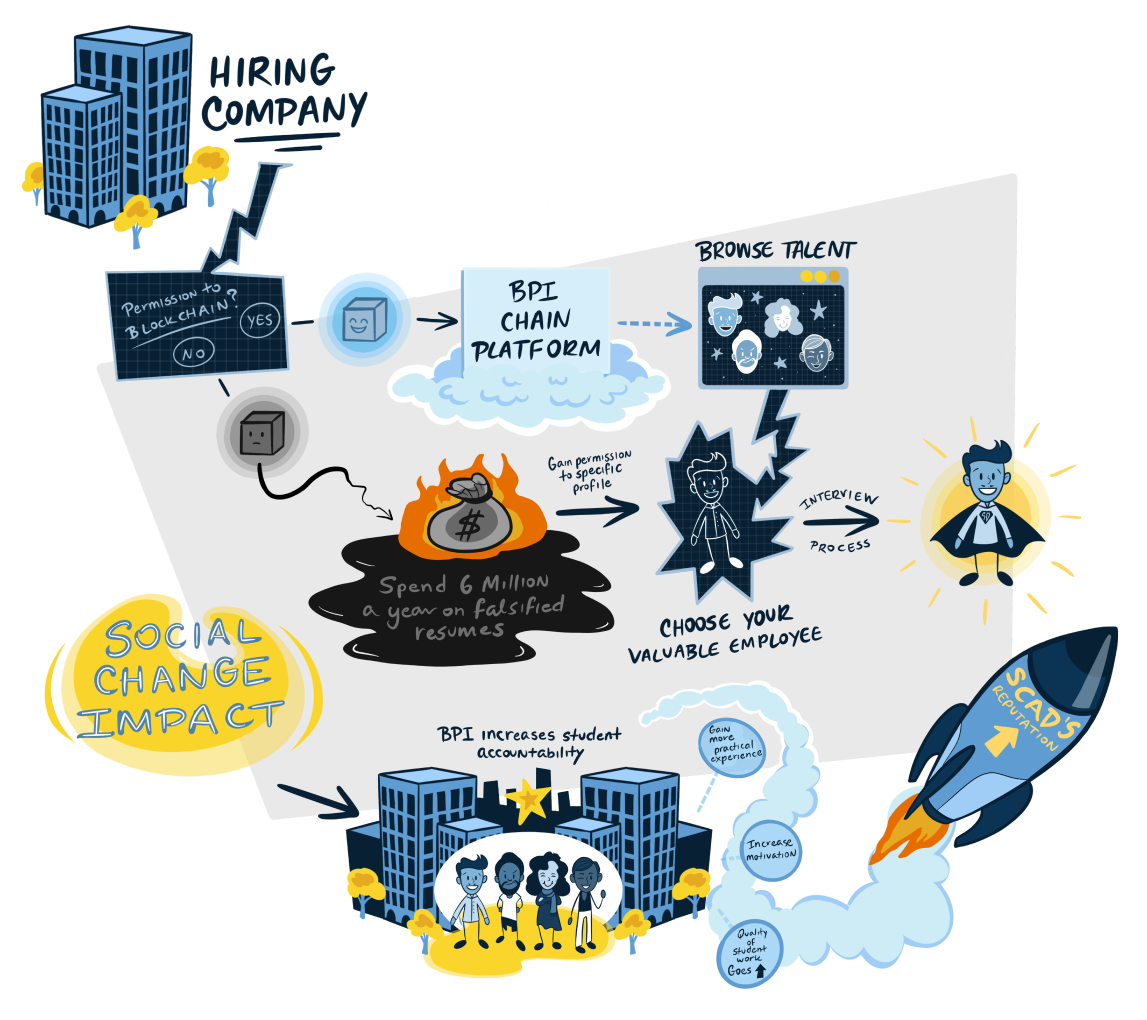
How a recruiter reads that record, compares candidates, and verifies what they are seeing.